The Drone War Changed How Wars Are Fought
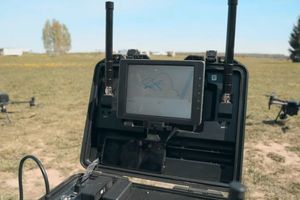
Modern UAV tech has completely flipped the old way of using drones. What we once wrote off as toys — your everyday Mavic or FPV — are now fighting on the front line right alongside conventional weapons. Air superiority at the drone level is a serious advantage, and it can turn the course of a war. This technology has cut recon times dramatically, made hitting a target far cheaper, and made troops safer. From a couple of kilometers out you can take out enemy personnel or equipment with an FPV or a Mavic drop — with minimal risk to the guy pulling the trigger.
War in the RF Spectrum
Almost every drone — except the ones flying on autopilot to preset waypoints or beacons — has one thing in common: it needs to send and receive a signal between the operator's controller and the drone itself. Any radio signal, whether it's the control link or the video feed coming off the drone, leaves a live trace in the spectrum — one you can actually see. Just ten years ago, scanning the airwaves in real time and watching the spectrum meant expensive lab equipment. Today you can do it out in the field with simple gear.
Scanning and watching the RF space around you on the fly lets you see what the eye can't. Personal, real-time signal recon — out where there are no usual emitters like Wi-Fi or cell networks — tells you a lot about what's around you. Is EW running, and on what frequencies, in what direction? Is there a drone in the air, where's it coming from and where's it headed? Is there a recon plane up there — closing in or moving off? Is GPS being jammed? And beyond the basic questions of spotting a drone and figuring out its direction, there's stuff that's useful to anyone near the zero line. In today's RF war, a device like this is starting to rank right up there with a plate carrier — because catching an FPV or some other buzzing thing early buys you precious minutes, or even seconds, to react. And it doesn't matter what branch you're in, volunteer or soldier alike. These scumbags launch FPVs even at ambulances.
HackRF One PortaPack H2 as a Drone Detector — and a Lot More
A portable, simple, and at the same time hugely capable personal tool for working with the airwaves gives you more information, can warn you about a threat in time, help you set up gear, throw a jamming signal, intercept video, or spoof GPS satellites — and that's only part of what it does.
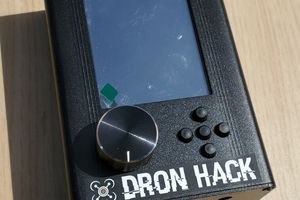
HackRF One PortaPack H2 with a built-in battery. The HackRF One PortaPack H2 is an SDR radio, compact, a ready-to-go portable setup for running the HackRF One. With its touchscreen, control buttons, built-in battery, and a slot for a micro SD card, it lets you work with the HackRF on the move, no computer needed. Out in the field you can scan, record, and play back recorded or generated signals on any frequency up to 6 GHz. The stock built-in battery gets you roughly 4–5 hours in scanning mode (depending on the ambient temperature and the load, with a standard battery), but it can also run off a regular phone power bank. It has a massive feature set and a wide range of uses.
The HackRF One is the SDR radio itself. The PortaPack is the add-on with a screen that lets you control the HackRF on the go. H2 is the marking for the second release of the PortaPack.
The HackRF One PortaPack H2 is a full-blown EW/SIGINT tool. For example — and this is nowhere near the full list — you can use it to:
- Scan the airwaves and check for interference or active EW in a chosen frequency band and direction.
- Triangulate the position of a signal source (with two devices).
- Emulate GPS satellites — spoof GPS coordinates on an enemy drone, or set a fake home point with the coordinates you need on your own drones of any type, in conditions where the real satellites are jammed or gone.
- Counter enemy drones at the spoofing level — swap the coordinates to an airport to force it to land while it's mid-flight.
- Detect any type of drone in the airspace — FPV, DJI, Autel, fixed-wing UAVs, recon birds, kamikazes, and so on — on any frequency up to 6 GHz, automatically, with an audio alert and a spectrum display.
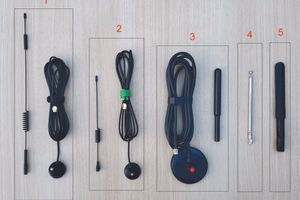
- Throw a jamming signal in a 24 MHz band to suppress signals on any frequency at low power. Paired with an amplifier tuned to the right frequency and the matching antennas from a jamming kit, it can be effective.
- Intercept and replay intercepted signals across the range up to 6 GHz.
- Intercept analog FPV video on any frequency.
- Listen in on unencrypted radio stations, and some DRM radios (using GNU Radio).
- Pull imagery from weather satellites, and intercept and replay control signals for automatic gates, barriers, roller shutters, and more.
- Show aircraft and vessels on a map — including drones that haven't turned off ADSB data transmission on 2.4 and 5.8 GHz.
- Generate data on any frequency you need — for example, emulating a drone, a radio, or any other transmitter, like automatic parking gates, barriers, and so on.
- Generate signals on frequencies up to 6 GHz.
- Do a whole lot more once it's hooked up to a PC.
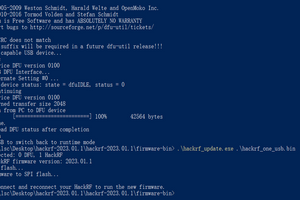
You can connect the HackRF One PortaPack H2 to a PC, install extra software on Windows — a spectrum analyzer, for instance — and watch the airwaves from your computer monitor. You can also build any working configuration you want yourself: scanning, decoding, transmitting data on a given frequency, or more complex use-case setups with the GNU Radio toolkit, if you've got the programming skills.
The HackRF One PortaPack H2 can also be connected to a Raspberry Pi and controlled remotely over the internet, given access, or run remotely. So you could, for example, build a remote system and run the HackRF from a safe spot. With a Raspberry Pi you can pull off a lot of HackRF ideas, since it's a mini Linux computer.
On the private DronHack blog we're gradually adding articles and guides with step-by-step instructions on exactly how to solve real-world tasks with the HackRF. The most relevant solutions are already written up.
Bottom Line
There's simply no way to cover the full feature set and every use case of the HackRF One PortaPack H2. The main thing to understand is this: with it you can do a whole lot of interesting things. For example, strap it to a small plane, do a couple of flights, look at the spectrum, and pinpoint the location of an emitter — like that trench or fixed EW station. For safety reasons, we're not laying out the full method or the extra gear you'd need for that in this article.
The HackRF One PortaPack H2 is a device every soldier needs — a personal EW/SIGINT tool with a broad feature set that'll come in handy out on the zero line, combining portability and ease of use compared to other SDRs.